The range · Made in Bayswater, Melbourne · Delivery Australia wide
Rosette Corner Blocks & Turned Fascia Rosettes
Compare three round fascia rosette sizes and six square architrave corner-block options in the shop. Each selected block or rosette is priced individually; choose its material and size before adding the quantity to your quote.
Choose rosette or corner-block size and material →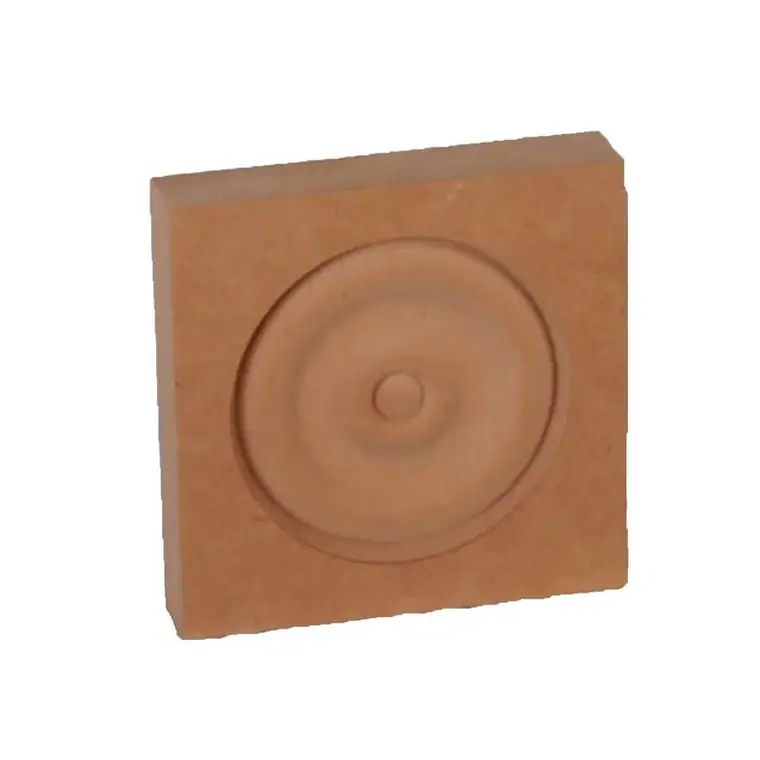
The range
Product photographs and profile drawings.
6 photographed · 2 scale profiles · 5 product codes. Select any one to see it larger.
Photographed
- ROSKDHW70 details and quote
- ROSKDHW90 details and quote
- ROSMDF70 details and quote
- ROSMDF90 details and quote
- ROSPINE70 details and quote
Scale profiles
Prices in the shop
See the prices and add to a quote.
See current prices and size choices in the shop. Where a product photograph or finished dimension is still being confirmed, the product listing says so. Add what you need and send it as one quote request; nothing is charged online.
What you get
- Australian made — every product, made in our Bayswater workshop since 1984
- An answer within one business day — we reply to enquiries and quote requests
- In stock, or made in 1 to 4 weeks — some of the range is in stock; the rest is made to order
- Timber-profile matching — from a photograph, drawing or sample
What is a turned fascia rosette?
A turned fascia rosette is a round timber disc, turned on a lathe, fixed to the cut end of a gable fascia board to finish it. The round range includes ROSE95, ROSE140 and ROSE190. The published product listings specify 22 mm thickness. Confirm the finished diameter and timber with the workshop before ordering, as the product codes are not a substitute for a confirmed measurement.
What is a rosette corner block, and where does it go?
A rosette corner block is a square block fitted at the top corner of an architrave, where the head architrave meets the jamb — the detail that lifts a doorway or window from plain to period-correct. It is an interior fitting, not a roofline product. Ours come in two sizes, 67 x 67mm and 92 x 92mm, in three materials:
- MDF — ROSMDF70 and ROSMDF90, 18mm thick
- Pine — ROSPINE70 and ROSPINE90, 19mm thick
- Kiln-dried hardwood — ROSKDHW70 and ROSKDHW90, 19mm thick
All six are available singly or in bulk packs of 50, which are priced lower per block. Compare the rosette prices for the material and quantity you need.
Which material should I choose?
Choose on the finish you are after. MDF and pine both suit a painted architrave; compare the current material and quantity quote for your order. Kiln-dried hardwood is the one to specify if the architraves are to be stained or clear finished, because the grain has to look right beside the surrounding timber. All three are supplied unfinished.
How many do I need, and what size?
Two blocks per opening — one at each top corner of the architrave. Count your doors and windows, then measure the width of the existing architrave and its thickness. The block should be at least as wide as the architrave it meets, so a narrow Victorian architrave takes the 67 x 67mm block and a wider one takes the 92 x 92mm. At 18mm and 19mm these blocks are close to standard architrave thickness, so take that measurement too.
Does the 25 year guarantee apply?
Only to the round range, and only outside. The ROSE fascia rosettes are treated pine, so as external LOSP H3 treated pine used above ground they carry our 25 year guarantee. The square rosette corner blocks are a different case: MDF, pine and kiln-dried hardwood are interior architrave fittings, they are not LOSP H3 treated, and they are not covered by the guarantee. Do not use MDF blocks externally.
Can you match an original rosette?
Yes, and it is common work — original blocks are usually painted over, split, or missing from one opening only. Send a clear photograph or one surviving block. The moulding matching guide explains how to show the face, section and scale together. Ask about our timber-profile matching service. Australian made, delivered to your home or site. Call 03 9720 1996.
How should they be finished?
Prime and paint on every face before fixing, cut edges included. For the external ROSE rosettes, use two thin coats of oil-based primer on all sides and give the timber 72 hours after delivery to acclimatise before painting — LOSP treatment needs an oil-based primer to bond. Interior blocks follow whatever system the rest of your architraves take.
Related pages
Talk to the workshop
Tell us the code and the size.
- Workshop852 Mountain Highway, Bayswater VIC 3153
- DeliveryAustralia wide
Product and ordering questions
What is a rosette corner block, and where does it go?
A rosette corner block is a square block fitted at the top corner of an architrave, where the head architrave meets the jamb. It is an interior fitting, not a roofline product. Ours come in 67 x 67mm and 92 x 92mm, in MDF, pine or kiln-dried hardwood.
Product information
Two different products are sold under the one name here, and they do completely different jobs. A turned fascia rosette is a round disc fitted to the end of a gable fascia board, outside, on the roofline. A rosette corner block is a small square block that sits at the top corner of a door or window architrave, inside, where the head trim meets the jamb trim. Heritage & Decorative Timber Products makes both — three diameters in the round range, two sizes and three materials in the square range.
Product sizes and buying questions
- What size details should I confirm for the ROSE95 rosette?
22 mm thick. Finished diameter requires confirmation before ordering. See ROSE95 in the shop for current pricing and quote options.
- Where can I check the 70 mm hardwood architrave corner block?
67 × 67 mm face; 19 mm thick. See ROSKDHW70 in the shop for current pricing and quote options.
At Heritage Decorative Timber, we are the best choice for period timberwork when the details of your project matter.
Buying questions (10)
How do I choose rosette blocks for a timber architrave?
Measure the face width and thickness of the architrave. Compare the block’s face and projection at the joint, and confirm the block dimensions against the exact profile before buying.
Where does an architrave corner block go?
It can sit at the upper corner of a door or window surround where the vertical and horizontal architraves meet.
What is the difference between a rosette and a plain corner block?
A rosette has a decorative motif. A plain block has a simpler face. Compare their overall size and projection as well as the face design.
How do I measure an original corner block?
Measure the face width, height and thickness. Take a front and side photo with a ruler.
Can I use corner blocks on only one side of an opening?
You can plan different treatments for each face. Photograph both sides and specify which side gets the blocks.
How do I compare a corner block with thick existing trim?
Hold a straightedge across the trim and measure its projection from the wall. Compare it with the block at the intended joint.
How many corner blocks do I need for a doorway?
Count the joints you plan to finish with a block. A doorway with blocks at both top corners uses two per treated face.
Can I match a missing rosette using the opposite corner?
Photograph the surviving block square-on and from the edge. Record the overall dimensions and central motif.
What should I check before painting a timber corner block?
Check the preparation and finish instructions for the timber supplied and the coating you intend to use.
Do I need to choose the architrave before the corner blocks?
It helps to know the architrave width and thickness first so you can compare the junction.